A new analysis of more than 50,000 brands found that once a brand becomes the answer an AI gives for a topic, it holds that spot about 90 percent of the time from one month to the next. The window to become that brand is wider open than it sounds. Almost nine in ten of those topics don't have an owner yet.
That combination is the whole reason topical authority is worth your attention right now. It isn't about chasing traffic across every subject you could plausibly write about. It's about claiming a position in a small number of topics that matter, because the position compounds, and it holds.
Once you're the answer, you tend to stay the answer.
The study tracked more than a thousand categories in ChatGPT across the first half of 2026, and counted a brand as a topic owner when it got named in at least four of five test questions and led the runner-up by a clear margin. Those owners kept first place about 90 percent of the time, month over month. The ones who got knocked off had one thing in common: a thin lead. The leaders who lost their spot were ahead by barely more than a point. The ones who held were ahead by nearly three. This matches what we see running visibility tracking for clients: a thin lead is the one that gets taken. Being a little ahead isn't the same as owning the topic.
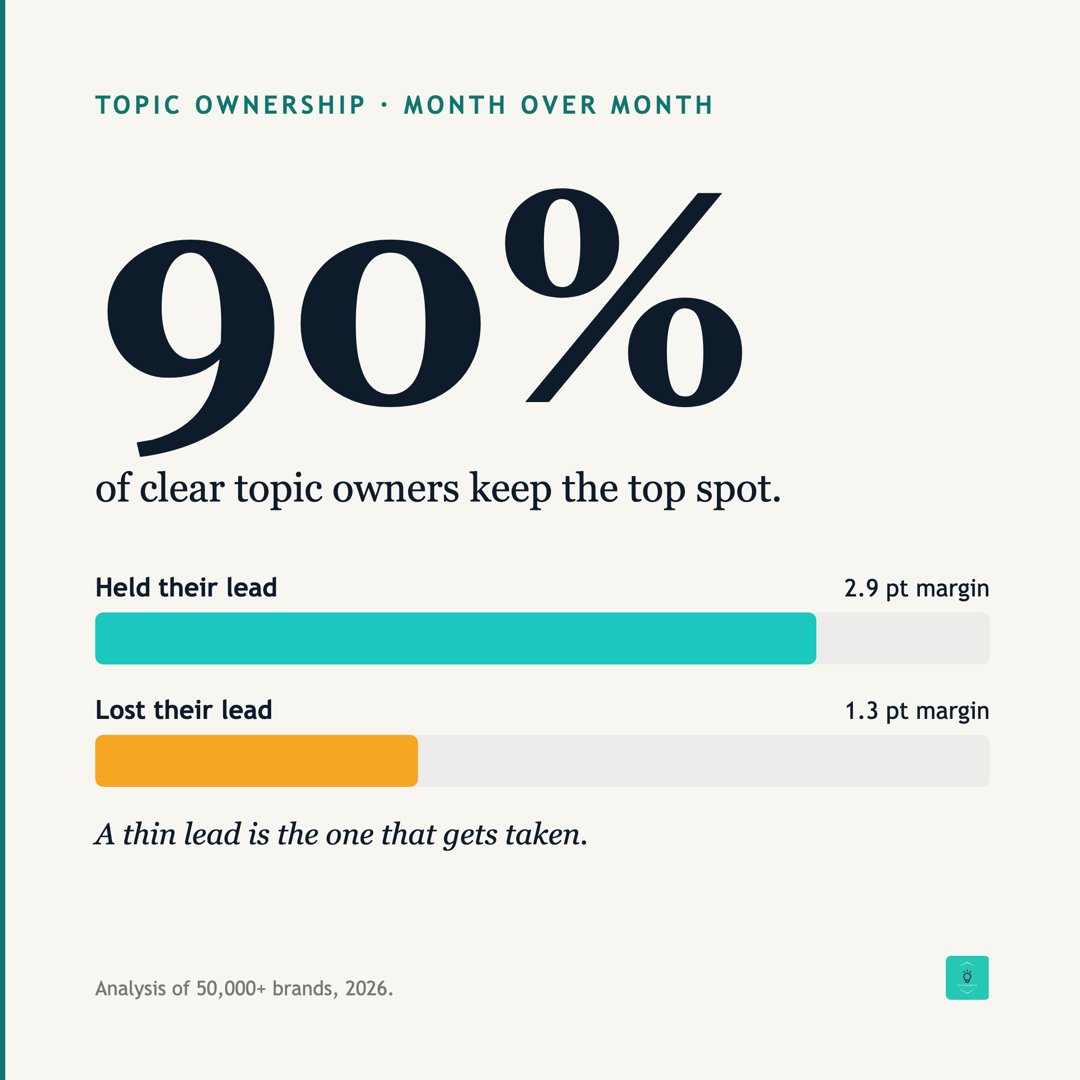
Almost nobody owns their category yet.
Only about 15 percent of the topics studied had a clear owner. More than half were open fields with no settled leader at all. And the biggest topics, the ones with the most demand behind them, were the least likely to have an owner. Add it up and roughly 89 percent of AI-search demand sits in topics nobody owns yet. That won't last. The cost of picking the wrong few topics today is lower than it will be a year from now, once the fields start to settle.
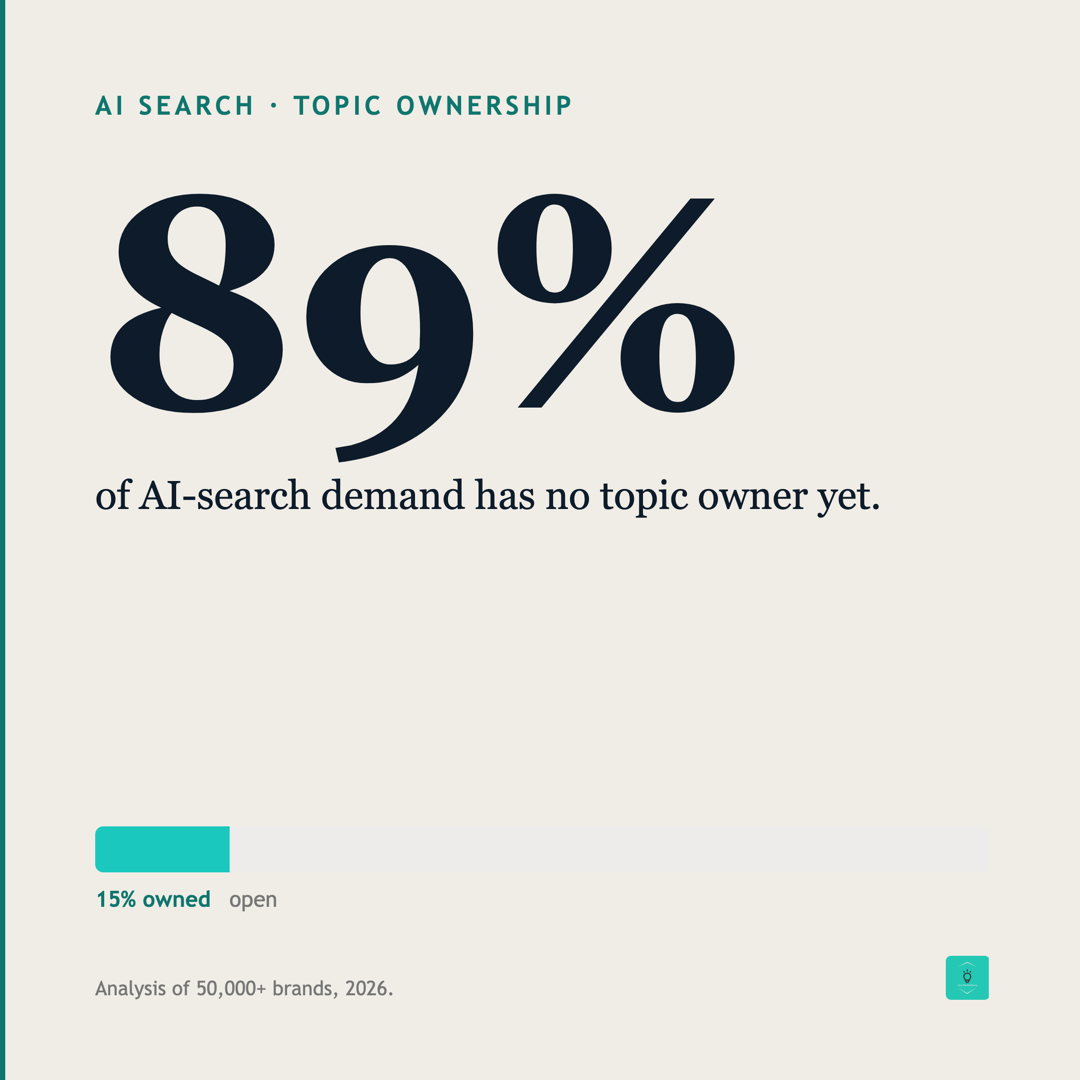
Being named beats being linked.
Here's the part that trips people up. The source an AI cites and the brand an AI names aren't the same thing. In this data they were almost unrelated. The most-cited source was also the most-named brand only about one time in five, and if anything the two drifted in opposite directions. What a reader acts on is the brand the answer says out loud, not the citation tucked underneath it. Worth noting too: homepages were cited only about four percent of the time. The pages doing the work were product and service pages, and genuinely useful explanatory content, not the front door.
The scoreboard isn't clicks anymore. It isn't even citations. It's whether the answer says your name.
So pick your ground, and defend it.
The brands that spread themselves across every loosely related topic rarely build up enough presence in any one of them to make a lead stick. The move is the opposite of broad. Choose a small number of topics that actually connect to revenue. Become the brand the AI names for those. Hold them. And be honest about the ones where an established name already owns nearly every answer, because that's the expensive fight, and it's usually not the one to pick first. How settled a category even is depends on what you sell. In retail, somebody already owns about six in ten categories. In legal and healthcare, almost no one does. That cuts both ways. An empty field is sometimes empty for a reason. It's also the one where the lead is still sitting there for the taking.
Topical authority didn't fade in AI search. It got more valuable, because ownership sticks. The topics are mostly unclaimed today, and they won't be for long. Pick the few you want to be the answer for, and start before the field settles.
If you had to pick three topics you'd want to be the answer for, what would they be? That's the question worth sitting with this week. It's the one we start with too. We can show you which topics you already own, which are still open, and whether you're holding your lead.
Frequently asked questions
Topical authority in AI search is being the brand an AI names when someone asks about a topic. Unlike a single ranking or citation, it tends to hold from month to month, which makes it a durable asset rather than a one-time placement.
Yes. An analysis of more than 50,000 brands found clear topic owners kept the top spot about 90 percent of the time month over month. Ownership is the durable payoff that answer engine and generative engine optimization work builds toward.
No. The website an AI cites and the brand it names are often different, and in this study they were almost unrelated. Ownership is measured by which brand the answer names, not which source it links to.
In that same analysis of more than 50,000 brands, only about 15 percent of topics had a clear owner, and roughly 89 percent of AI-search demand sat in topics with no owner yet.
Concentrate. Pick a small number of topics that connect to revenue and work to become the brand AI answers name for those, rather than spreading content across every loosely related subject. Broad coverage rarely builds enough presence in any one topic to make a lead stick, and a narrow lead is the one that gets taken.
Sources
- Kevin Indig, Does Topical Authority Matter in AI Search?, Growth Memo (July 2026), analyzing Semrush AI Visibility Index data across 1,094 US ChatGPT categories and more than 50,000 brands, January through June 2026. Source for the topic-ownership figures here: month-over-month retention, the lead margin separating owners who held from those who lost the spot, the share of categories with a clear owner, the share of AI-search demand still unclaimed, page-type citation shares, and the gap between the most-cited source and the most-named brand.